
How Much eSIM Data Do You Need for Travel? 7, 14 & 30-Day Guide
Not sure how many GB you need abroad? Use this practical guide to choose the right eSIM data plan for a 7-day, 14-day, or 30-day trip.

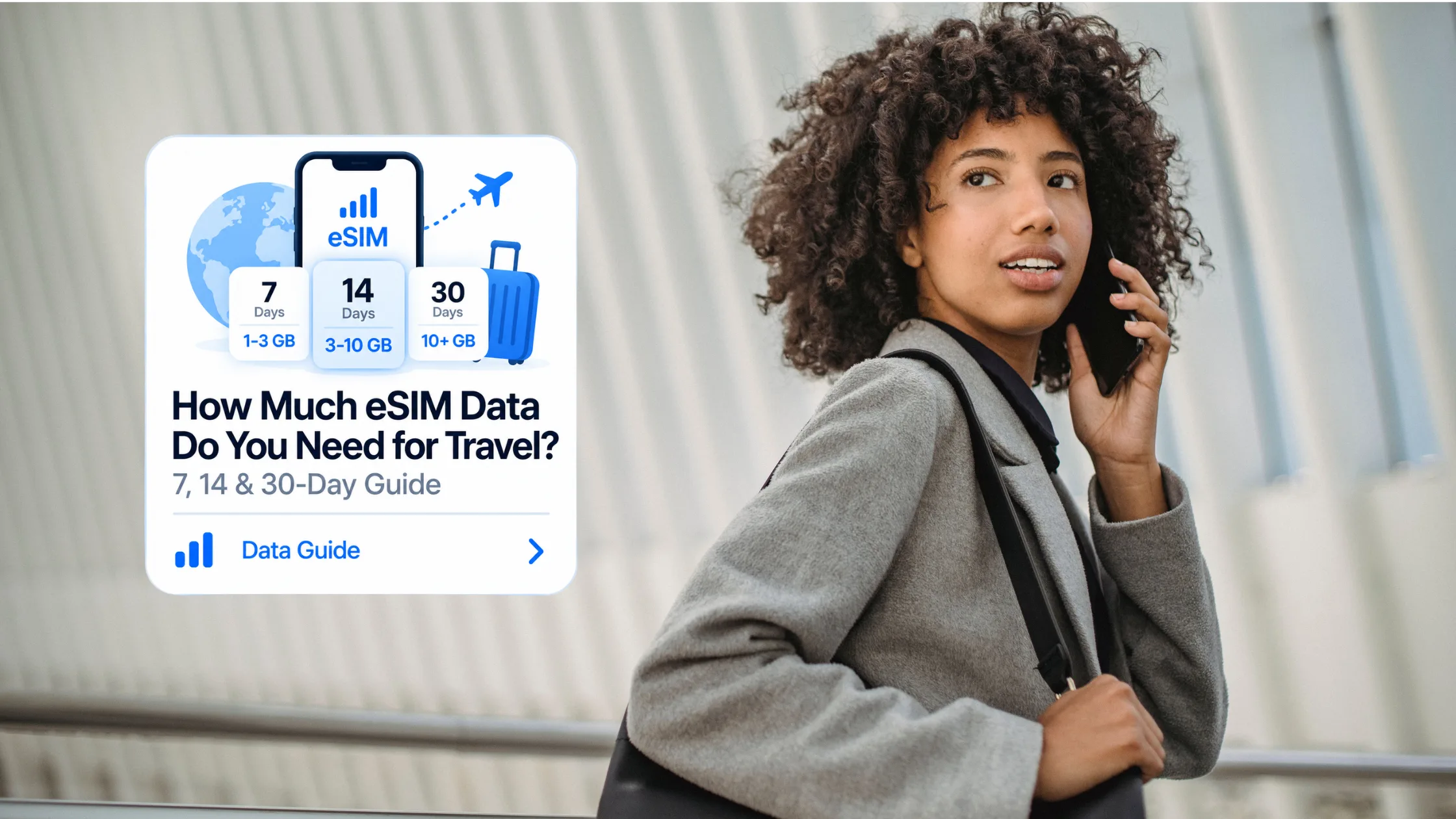
Planning a trip and wondering how many GB you actually need?
Choosing too little data can leave you searching for Wi-Fi when you need Google Maps, transport apps, hotel details, or a quick message home. Choosing too much can mean paying for data you never use.
The right travel eSIM plan depends mainly on:
How long you are travelling
How often you will have access to Wi-Fi
Whether you mainly use maps and messaging, or stream videos and work online
This guide will help you choose the right amount of eSIM data for a 7-day, 14-day, or 30-day trip.
Quick Answer: How Much eSIM Data Do I Need?
For most travellers, these are good starting points:
Light use
7 days: 1–3 GB
14 days: 3–5 GB
30 days: 5–10 GB
Normal travel use
7 days: 3–5 GB
14 days: 5–10 GB
30 days: 10–20 GB
Heavy use
7 days: 10 GB+
14 days: 15–20 GB+
30 days: 30 GB+
These are general estimates. Your real usage depends on your hotel Wi-Fi, how much you use social media, whether you watch videos, use hotspotting, upload photos, or make video calls.
For most travellers using maps, WhatsApp, transport apps, browsing, and some social media, a 5 GB plan for one week or a 10 GB plan for two weeks is usually a comfortable choice.
Choose Your Plan Based on Your Travel Style
1. Light Data User
A light user mainly needs mobile data for practical travel tasks.
You may be a light user if you mostly use:
Google Maps or Apple Maps
WhatsApp messages
Email
Uber, Bolt, Grab, or local transport apps
Hotel bookings and boarding passes
Restaurant searches
Occasional social media
Recommended data
7-day trip: 1–3 GB
14-day trip: 3–5 GB
30-day trip: 5–10 GB
This can work very well if you connect to Wi-Fi at hotels, cafés, airports, or apartments.
2. Normal Travel Data User
Most travellers fit into this category.
You may be a normal data user if you use maps every day, upload some photos, scroll social media, message friends or family, search for restaurants, book activities, and use ride-sharing apps.
Recommended data
7-day trip: 3–5 GB
14-day trip: 5–10 GB
30-day trip: 10–20 GB
This is usually the safest option for a holiday, city break, multi-country Europe trip, or two-week backpacking trip.
3. Heavy Data User
You may need more data if you regularly:
Watch YouTube, Netflix, TikTok, or Instagram Reels on mobile data
Upload many photos and videos
Make video calls
Use your phone as a hotspot for a laptop
Work remotely while travelling
Use navigation for several hours every day
Travel without reliable hotel Wi-Fi
Recommended data
7-day trip: 10 GB or more
14-day trip: 15–20 GB or more
30-day trip: 30 GB or more
If you need data for remote work or hotspotting, choose more data than you think you need. Video calls, cloud backups, and laptop tethering can use data much faster than normal travel browsing.
How Much Data Do Common Travel Apps Use?
Different apps use very different amounts of data.
Low-data activities
These normally use relatively little data:
Sending WhatsApp messages
Checking emails
Looking up restaurant opening hours
Booking trains, flights, or accommodation
Using translation apps
Checking public transport routes
Viewing digital boarding passes
Medium-data activities
These use more data, especially when used every day:
Google Maps navigation
Instagram scrolling
Uploading travel photos
Browsing social media
Listening to music
WhatsApp or FaceTime audio calls
Video calls in lower quality
High-data activities
These can use a lot of your eSIM data:
Watching Netflix or YouTube
Uploading high-quality videos
Long video calls
Hotspotting a laptop
Downloading large apps or software updates
Automatic photo backups
Uploading files to Google Drive, iCloud, or Dropbox
A good travel habit is to download maps, playlists, movies, podcasts, and travel documents before leaving Wi-Fi.
How Much Data Do You Need for a 7-Day Trip?
For a one-week trip, most travellers do not need unlimited data.
Choose 1–3 GB if you mainly use maps, messaging, travel bookings, and regularly connect to Wi-Fi.
Choose 3–5 GB if you use maps, social media, transport apps, browsing, and travel apps every day.
Choose 10 GB or more if you stream videos, upload content, hotspot a laptop, or make frequent video calls.
For a city break in Paris, Rome, Barcelona, Istanbul, Dubai, Tokyo, or New York, 3–5 GB is usually a good middle option.
It gives you enough data for navigation, booking tickets, messaging friends, checking restaurant reviews, ride-sharing, and sharing a few travel photos.
How Much Data Do You Need for a 14-Day Trip?
For two weeks abroad, your data choice matters more.
Choose 3–5 GB if you use Wi-Fi often and only need essential travel data.
Choose 5–10 GB for normal holiday use, including maps, social media, browsing, and messaging.
Choose 15–20 GB or more for frequent social media, video calls, hotspotting, or heavier use.
For a two-week Europe trip, a regional eSIM can be easier than buying separate plans for every country.
For example, if your route includes France, Italy, Spain, Germany, and Portugal, one Europe eSIM can help keep you connected without changing plans at every border.
Explore country and regional eSIM plans
How Much Data Do You Need for a 30-Day Trip?
For a month-long trip, think carefully about whether you will have reliable Wi-Fi.
Choose 5–10 GB if you mostly use Wi-Fi and need data only when outside.
Choose 10–20 GB for normal travel, regular maps, social media, and messaging.
Choose 30 GB or more if you work remotely, stream often, upload content, or use a hotspot.
If you are travelling for a month through several countries, a regional eSIM can be much easier than buying a new local SIM card in every destination.
Should You Buy a Country eSIM or a Regional eSIM?
Choose a country eSIM when:
You are staying in one country
You want a plan focused on one destination
You are taking a short holiday
You do not plan to cross borders
Choose a regional eSIM when:
You are visiting several countries
You are travelling around Europe, Asia, the Gulf, or South America
You want one eSIM for your full route
You do not want to install a new eSIM every few days
For example:
France only: Choose a France eSIM.
Italy, France, Spain, and Portugal: Choose a Europe eSIM.
Thailand, Vietnam, Japan, and South Korea: Choose an Asia regional eSIM.
UAE, Saudi Arabia, Qatar, Kuwait, Bahrain, and Iraq: Choose a Gulf regional eSIM.
Before buying, always check the countries included in a regional plan.
How to Use Less Data While Travelling
Before you travel
Download offline maps for your destination
Download playlists, podcasts, and movies while connected to Wi-Fi
Turn off automatic app updates
Turn off cloud photo backup on mobile data
Download hotel confirmations, tickets, and travel documents
Save important addresses in your maps app
While you travel
Use hotel Wi-Fi for video uploads
Avoid streaming in high quality on mobile data
Turn off background data for apps you do not need
Use Wi-Fi for large uploads and software updates
Check which apps are using the most data in your phone settings
Keep Your Normal Number While Using a Travel eSIM
A travel eSIM can usually be used for mobile data while your main SIM stays active for calls, texts, and WhatsApp verification.
Before you leave, make sure that:
Your phone is unlocked.
Your phone supports eSIM.
Your travel eSIM is selected for mobile data.
Data roaming is enabled for the travel eSIM when required.
Mobile data roaming is disabled on your home SIM if you want to avoid carrier roaming charges.
Check whether your device supports eSIM
Frequently Asked Questions
Is 1 GB enough for a trip?
One GB can be enough for a short trip if you mainly use messaging, maps, and Wi-Fi. For a full week of normal travel use, 3–5 GB is usually a safer choice.
Is 5 GB enough for 7 days?
For most travellers, yes. A 5 GB plan is generally enough for maps, messaging, transport apps, browsing, and moderate social media use during a one-week trip.
Is 10 GB enough for two weeks?
For many travellers, yes. Ten GB is a good choice for a two-week trip if you use maps daily, post occasionally on social media, and have Wi-Fi at your hotel or apartment.
Is 20 GB enough for a month?
It can be enough for normal travel use, especially if you use Wi-Fi often. If you work remotely, stream video, upload content, or hotspot a laptop, consider a larger plan.
Should I choose unlimited data?
Unlimited data can be useful for heavy users, remote workers, or travellers who want maximum flexibility. Always check whether the plan has a fair-use policy, speed limit, or hotspot restriction before buying.
Can I top up if I run out of data?
This depends on the specific plan. Before buying, check whether your plan allows top-ups or whether you would need to purchase another eSIM package.
Choose the Right eSIM Plan for Your Trip
The best travel eSIM is not always the biggest plan. Choose the amount of data that matches your trip length, travel style, and Wi-Fi access.
For a simple holiday, 3–5 GB may be enough. For a longer multi-country trip, 10–20 GB can give you more freedom. For remote work, streaming, or frequent hotspot use, choose a larger plan.
Next steps
If you are weighing an unlimited plan against a fixed allowance, read what fair use policy really means first. Travelling through several countries? See regional eSIM vs single-country eSIM. And if a price looks odd, why identical plans cost different amounts explains it. Ready to buy? Browse destinations.